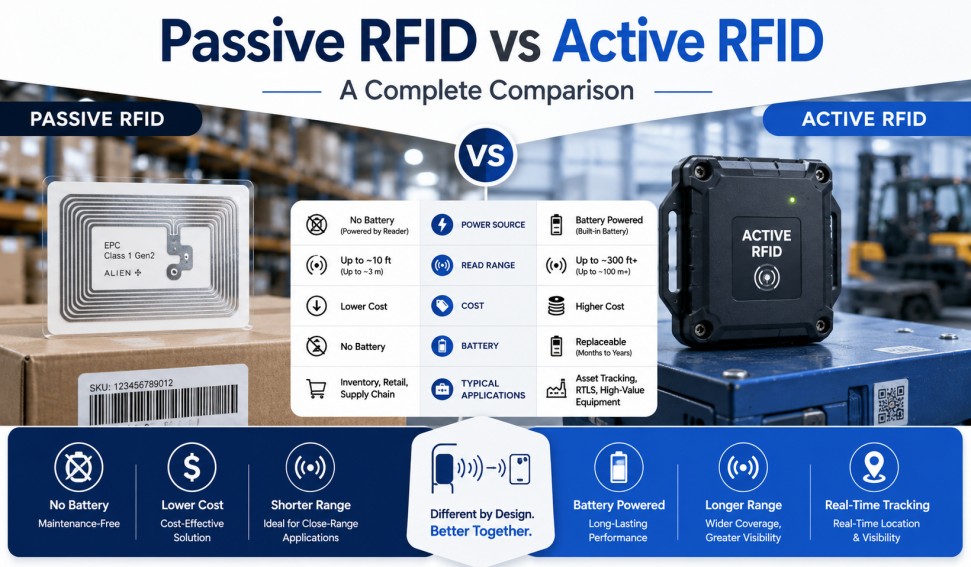
The main difference between passive RFID and active RFID is how the tag is powered and how it communicates. A passive tag has no radio transmitter and normally no battery. It receives energy from a reader field and responds through coupling or backscatter. An active tag has its own power source and transmitter and can broadcast a signal over a longer distance.
That difference affects tag size, cost, range, maintenance, sensor support, infrastructure, and suitable use cases. Passive RFID is widely used for item-level inventory and identification. Active RFID is commonly considered for high-value mobile assets and location applications.
This guide compares passive RFID, active RFID, and battery-assisted passive RFID so businesses can select the correct architecture.
What Is Passive RFID?
A passive RFID tag contains a chip and antenna but does not use its own radio transmitter. The reader creates an electromagnetic or magnetic field that activates the tag.
In passive UHF RFID, the tag changes the reflection of the reader signal to return data. In LF and HF systems, communication normally relies on near-field coupling.
Passive RFID tags are available as:
-
Paper or synthetic labels
-
Dry and wet inlays
-
Hangtags
-
Cards and tickets
-
Wristbands
-
Laundry tags
-
On-metal labels
-
ABS, PCB, ceramic, and other industrial tags
-
Animal transponders
What Is Active RFID?
An active RFID tag contains a battery or another internal power source and a radio transmitter. It can broadcast at defined intervals or according to a trigger, depending on the system.
Active tags may support:
-
Longer communication range
-
Periodic beacon signals
-
Motion, temperature, humidity, or other sensors
-
Real-time or near-real-time location workflows
-
Alarm or status reporting
Because the tag contains a power source and transmitter, it is usually larger and more expensive than a passive label.
What Is Battery-Assisted Passive RFID?
Battery-assisted passive RFID, often abbreviated BAP, sits between passive and active designs.
A BAP tag uses a battery to power the chip or sensor, which can improve sensitivity or enable data logging. It still communicates by responding to the reader signal rather than continuously broadcasting with a fully active transmitter.
BAP tags may be useful for:
-
Temperature monitoring
-
Sensor-enhanced logistics
-
Challenging read conditions
-
Applications needing longer sensor operation without a fully active network
Passive RFID vs Active RFID Comparison Table
| Factor | Passive RFID | Active RFID | Battery-assisted passive RFID |
|---|---|---|---|
| Internal battery | No, in most designs | Yes | Yes |
| Radio transmitter | No | Yes | Normally no active transmitter |
| Communication | Coupling or backscatter | Broadcast or two-way active communication | Passive-style response with battery-powered circuitry |
| Typical range | Close to several meters, depending on frequency and system | Often tens of meters or more, system dependent | Usually greater sensitivity or sensing capability than standard passive |
| Tag size | Very small to industrial | Usually larger | Medium to large |
| Tag cost | Lowest | Highest | Between passive and active |
| Maintenance | No battery replacement | Battery lifecycle management | Battery lifecycle management |
| Multi-item inventory | Strong with passive UHF | System dependent | System dependent |
| Sensor support | Limited or specialized | Strong | Strong for selected sensors |
| Common use | Retail, logistics, assets, access, cards, industrial ID | RTLS, vehicles, yards, high-value assets | Sensor logistics and specialized tracking |
Passive RFID Advantages
Lower Tag Cost
Passive labels can be economical enough for item-level tagging in retail, logistics, and manufacturing.
Small Form Factors
Without a battery and transmitter, passive RFID can be integrated into labels, tickets, cards, wristbands, packaging, garments, and compact industrial tags.
Minimal Maintenance
A passive tag does not require battery replacement. Service life is primarily determined by materials, chip attachment, environmental exposure, and mechanical wear.
High-Volume Identification
Passive UHF RFID can identify many tags quickly in inventory and supply-chain workflows.
Broad Range of Frequencies and Forms
Passive RFID includes LF animal tags, HF cards and labels, NFC tags, UHF labels, laundry tags, and durable industrial tags.
Passive RFID Limitations
Reader-Dependent Operation
The tag must receive sufficient energy from a compatible reader.
Shorter Range Than Active Systems
Passive read range is limited by frequency, antenna, tag sensitivity, regulations, and environment.
Material Sensitivity
Metal, liquids, shielding, orientation, and small item size can affect performance.
Limited Sensor Power
Battery-free sensors exist, but available power and sensing behavior are more constrained than in an active tag.
Active RFID Advantages
Longer Communication Range
The onboard transmitter allows active tags to communicate over substantially longer distances than most passive tags.
Frequent Location Updates
Active tags can transmit beacons at scheduled intervals, enabling location systems to monitor moving high-value assets.
Sensor Capability
The battery can power environmental sensors, memory, alarms, and local processing.
Strong Signal Availability
An active transmitter can provide a more detectable signal in large sites, although infrastructure and radio conditions still matter.
Active RFID Limitations
Higher Tag Cost
Active tags are usually reserved for assets whose value or operational importance justifies the cost.
Battery Lifecycle
Battery capacity, beacon interval, temperature, sensor use, and transmission power affect service life. Recharging or replacement must be planned.
Larger Size
Battery and enclosure requirements make active tags larger than passive labels.
More Complex Infrastructure
Location systems may require gateways, anchors, calibration, maps, cloud or server software, and ongoing device management.
Technology Ecosystem Differences
Active RFID is not one universal protocol. Systems may use different frequency bands, communication methods, and location algorithms, so interoperability must be evaluated carefully.
Read Range: What the Numbers Really Mean
Published read range should be treated as a design estimate, not a guaranteed result.
Passive RFID Range Depends On:
-
Frequency
-
Reader transmit power
-
Reader antenna gain and polarization
-
Tag antenna and chip sensitivity
-
Tagged material
-
Orientation
-
Cable loss
-
Interference
-
Regional regulations
Passive LF and HF commonly operate at close range. Passive UHF can operate from near contact to several meters or more with suitable tags and infrastructure.
Active RFID Range Depends On:
-
Tag transmit power
-
Gateway sensitivity
-
Frequency and protocol
-
Antenna design
-
Building construction
-
Obstacles and interference
-
Beacon interval
-
Regulatory power limits
Some active systems cover tens of meters or more, but reliable location accuracy is a separate question from basic signal detection.
Applications for Passive RFID
Retail and Apparel
Low-cost UHF labels support item-level inventory, replenishment, omnichannel fulfillment, and returns.
Logistics and Warehousing
Passive tags identify cartons, pallets, returnable assets, and shipments at handheld or fixed read points.
Manufacturing
Durable tags track work-in-process, components, tools, molds, carriers, and finished goods.
Access and Identification
LF, HF, and NFC cards, key fobs, wristbands, and labels support access control, membership, ticketing, and authentication.
Laundry and Textiles
Washable passive RFID tags identify garments, linens, uniforms, and rental textiles through repeated laundry cycles.
Applications for Active RFID
Real-Time Location Systems
Active tags can help monitor mobile equipment, vehicles, containers, and high-value assets across large sites.
Yard and Fleet Visibility
Battery-powered tags can identify trailers, vehicles, and transport assets where longer range is required.
Environmental Monitoring
Active tags can collect and transmit temperature, humidity, shock, or motion data, depending on the device.
Personnel Safety
Specialized active badges may support duress alerts, mustering, or worker location in controlled systems.
How to Choose Between Passive and Active RFID
Choose Passive RFID When:
-
Large numbers of items need tags
-
Tag cost must be low
-
The required read range is close to several meters
-
Inventory and identification are the main objectives
-
Battery maintenance is undesirable
-
Labels, cards, wristbands, or small tags are required
Choose Active RFID When:
-
Assets are high value
-
Long-range broadcasts are required
-
Frequent location updates are necessary
-
Sensors need continuous battery power
-
Larger tag size and higher cost are acceptable
-
Battery management can be supported
Consider BAP When:
-
Sensor or chip power is needed
-
A passive reader infrastructure is preferred
-
Increased sensitivity is valuable
-
A fully active transmitter is unnecessary
Total Cost of Ownership
A correct comparison includes more than tag price.
Passive System Costs
-
Tags or labels
-
Readers and antennas
-
Printing and encoding
-
Middleware and integration
-
Installation and testing
Active System Costs
-
Active tags
-
Gateways, anchors, or access points
-
Batteries or charging
-
Device management
-
Location software
-
Calibration and mapping
-
Replacement and maintenance
The business value should be measured against asset loss, search time, utilization, downtime, compliance, and operational risk.
Can Passive and Active RFID Work Together?
Yes. A facility may use passive UHF for inventory and active RFID for high-value mobile equipment. NFC may support maintenance interactions, while barcodes provide visual backup.
The technologies should share business identifiers and software rules where possible, even if their radio systems are different.
Frequently Asked Questions
Do passive RFID tags last forever?
A passive tag has no battery to expire, but it can still fail because of physical damage, material degradation, chip-antenna connection failure, chemicals, temperature, or mechanical stress.
Are all UHF tags passive?
No. Many supply-chain UHF tags are passive, but active and battery-assisted systems can also operate in UHF or other bands.
Is active RFID the same as GPS?
No. Active RFID communicates with local readers or gateways. GPS calculates position using satellite signals. Some tracking devices combine GPS, cellular communication, and other technologies, but that is a different architecture.
Which RFID type is more accurate?
Accuracy depends on the goal. Passive RFID can provide highly reliable item identification at a read point. Active RFID can provide frequent location updates, but precise position accuracy depends on infrastructure and algorithms.
Which RFID type is cheaper?
Passive tags are generally less expensive and require no battery maintenance. Active systems may deliver greater value for high-value assets where long range, location, or sensors justify the higher cost.
Conclusion
Passive RFID is optimized for economical identification at scale. Active RFID is optimized for powered communication, longer range, frequent location updates, and sensors. Battery-assisted passive RFID provides a middle option for specialized sensing and performance needs.
The correct decision should be based on the business event, asset value, range, environment, tag quantity, data frequency, maintenance capacity, and total cost of ownership.
Comparing RFID architectures for your project? GSRFID can help evaluate passive labels, cards, wristbands, laundry tags, on-metal tags, industrial tags, readers, and antennas, and can coordinate product testing for the intended item and environment.