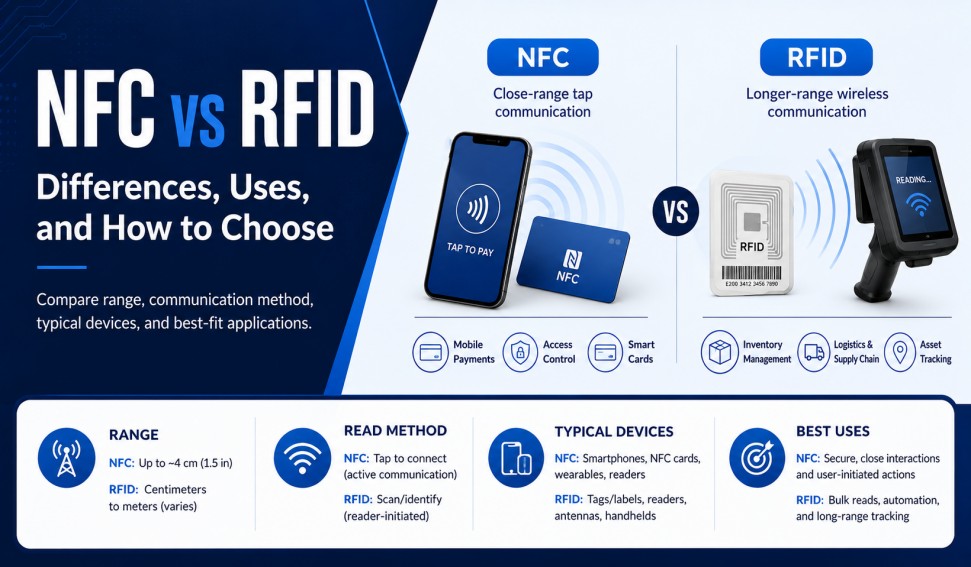
NFC vs RFID is a common comparison, but NFC is not a completely separate technology. NFC, or Near Field Communication, operates at 13.56 MHz and belongs to the broader RFID family. The real comparison is usually between NFC's close, intentional smartphone-friendly interaction and other RFID systems designed for access, inventory, logistics, manufacturing, or asset tracking.
NFC is ideal for tap-based experiences. UHF RFID is ideal for reading many tagged items quickly. HF and LF RFID support other controlled identification workflows. Selecting the right technology depends on range, reader type, number of items, user interaction, security design, and operating environment.
Is NFC a Type of RFID?
Yes. RFID is the broad category of technologies that identify or communicate with tags through radio frequency.
The RFID family includes:
-
LF RFID, commonly around 125-134.2 kHz
-
HF RFID at 13.56 MHz
-
NFC at 13.56 MHz with NFC-specific specifications
-
UHF RFID or RAIN RFID in region-specific UHF bands
-
Active RFID systems using powered tags
NFC is therefore a specialized form of HF contactless communication, designed for devices that are very close to each other.
NFC vs RFID Comparison Table
| Factor | NFC | Other RFID, especially UHF |
|---|---|---|
| Frequency | 13.56 MHz | LF, HF, UHF, or active system bands |
| Typical interaction | Tap or a few centimeters | Close range to several meters, system dependent |
| Smartphone support | Strong | UHF normally requires a dedicated reader |
| Number of tags | Usually one intentional interaction | UHF can identify many tags in one read zone |
| User experience | Consumer or employee taps item | Automatic or operator-driven inventory |
| Direction of communication | Supports defined NFC device and tag interactions | Depends on RFID technology and protocol |
| Common tags | NFC labels, cards, wristbands, key fobs | Labels, inlays, cards, hard tags, industrial tags |
| Common applications | Payment, access, authentication, smart packaging | Inventory, logistics, manufacturing, assets, access |
| Read-zone control | Naturally short | Must be engineered for intended coverage |
| Security | Depends on chip, application, keys, backend, and process | Also depends on chip, protocol, backend, and process |
How NFC Works
An NFC-enabled phone or reader creates a short-range 13.56 MHz field. A passive NFC tag receives energy from the field and returns data.
The user normally brings the phone or card close to the target. This intentional action is one of NFC's main advantages: the physical tap provides clear context about which item the user wants to interact with.
An NFC tag may provide:
-
A web address
-
Product information
-
An authentication response
-
A digital business card
-
Access credentials
-
Device-pairing information
-
Maintenance instructions
-
A unique identifier connected to a cloud record
The capability depends on the tag chip, data format, phone, application, and backend system.
How UHF RFID Works
A UHF reader sends radio energy through an antenna. Passive UHF tags in the read zone receive energy and respond through backscatter.
A properly designed system can identify many tags quickly without a user tapping each one. This makes UHF suitable for:
-
Store inventory
-
Warehouse receiving
-
Carton and pallet verification
-
Manufacturing tracking
-
Asset audits
-
Laundry and textile management
-
Automated portals and cabinets
UHF normally requires a dedicated handheld or fixed reader rather than a standard smartphone.
NFC Advantages
Smartphone Compatibility
Many modern smartphones can read NFC tags, reducing the need for a dedicated reader in consumer-facing applications.
Intentional Interaction
The short range helps users select one item deliberately. This is useful for authentication, access, product information, and payment.
Simple User Experience
“Tapping” is familiar and requires little training.
Flexible Digital Content
An NFC tag can connect a physical product to a website, digital product passport, service record, instructions, registration page, or loyalty experience.
Security Options
Some NFC chips support cryptographic authentication, password protection, secure messaging, counters, or tamper-related functions. Security must be designed as a complete system rather than assumed from the word NFC.
NFC Limitations
Short Range
NFC is not intended for long-distance inventory or automatic doorway reads.
One-at-a-Time Interaction
The user normally interacts with one tag at a time, making NFC inefficient for counting thousands of items.
Device and Operating-System Behavior
Phone model, operating system, browser, app permissions, and tag data format can affect the experience.
Tag Placement
Metal and other materials can detune NFC antennas. On-metal NFC tags use specialized construction.
RFID Advantages Beyond NFC
Multiple Frequency Options
RFID can support animal identification, access cards, libraries, item-level inventory, industrial tracking, and long-range active systems.
Bulk Reading
Passive UHF is designed to identify many tags quickly in one read zone.
Fixed Automation
Readers can be installed at dock doors, conveyors, cabinets, shelves, gates, and production stations.
Longer Read Zones
UHF and active RFID can operate at substantially greater distances than NFC, depending on the system.
Wider Industrial Tag Range
RFID tags are available for high temperatures, metal surfaces, laundry, tools, vehicles, livestock, containers, and other demanding applications.
RFID Limitations Compared With NFC
Dedicated Reader Infrastructure
Most UHF, LF, and non-NFC HF systems require purpose-built readers.
Less Obvious User Intent
A longer read zone may detect nearby tags that were not part of the intended transaction. The system must use antenna design, sensors, shielding, power settings, and software logic to establish context.
More Complex Deployment
Bulk and automatic reading create greater requirements for site testing and software filtering.
NFC vs RFID for Common Applications
Product Authentication
NFC is often preferred when a consumer taps one product with a phone. A secure NFC chip and backend can create an intuitive authentication experience.
UHF may support supply-chain verification and inventory before the product reaches the consumer. Some products can use both technologies.
Retail Inventory
UHF RFID is usually the stronger choice because employees can count many items rapidly. NFC would require tapping items individually.
Smart Packaging
NFC is well suited to consumer content, product registration, instructions, loyalty, and authentication. UHF can add supply-chain visibility. A dual-frequency design may support both use cases when cost and packaging allow.
Access Control
NFC and HF cards are commonly used for intentional close-range access. UHF can support longer-range vehicle or hands-free identification, but the security model and read-zone design must match the risk.
Asset Tracking
UHF RFID is normally better for audits and automatic identification of many assets. NFC can supplement it with close-range maintenance records or technician interactions.
Payments
NFC is a widely established technology for contactless payment and card emulation. UHF RFID is not a direct substitute for standard consumer tap-to-pay systems.
Manufacturing
UHF supports work-in-process, tools, carriers, and material movement. NFC can provide machine setup data, maintenance instructions, or authenticated technician access at close range.
Security and Privacy: Avoid Simple Assumptions
Neither NFC nor RFID is automatically secure or insecure.
Security depends on:
-
Chip capabilities
-
Authentication method
-
Key management
-
Encryption or secure messaging
-
Data stored on the tag
-
Backend validation
-
Reader and app security
-
User permissions
-
Physical tag protection
-
Privacy and retention policy
A basic low-cost NFC tag that stores an open URL is not equivalent to a secure cryptographic tag. Similarly, a standard UHF inventory label is not the same as a tag designed for secure authentication.
How to Choose Between NFC and RFID
Choose NFC When:
-
A smartphone must read the tag
-
The user should tap one item intentionally
-
The application is consumer-facing
-
Product content, authentication, access, or pairing is required
-
A very short read range is desirable
Choose UHF RFID When:
-
Many items must be read quickly
-
Inventory counting is the main goal
-
Automatic portals, shelves, tunnels, or cabinets are needed
-
The process covers retail, logistics, manufacturing, or assets
-
Dedicated readers are acceptable
Choose HF or LF RFID When:
-
A controlled card, library, document, animal, or industrial identification workflow requires those standards
-
Smartphone interaction is not required
-
The selected frequency fits the material and read-zone needs
Consider Dual-Frequency Tags When:
-
The supply chain needs UHF inventory
-
The consumer needs NFC interaction
-
The product value supports the additional tag complexity
-
The packaging has enough space for both antenna systems
Frequently Asked Questions
Can a smartphone read UHF RFID tags?
Most standard smartphones support NFC, not passive UHF RFID. External UHF sleds or connected readers can add UHF capability to mobile devices.
Can an NFC reader read every HF RFID tag?
No. The reader and tag must support compatible standards, protocols, and modes. Sharing the same 13.56 MHz frequency does not guarantee interoperability.
Which has a longer range, NFC or RFID?
RFID is the broader category. NFC is intentionally short range. UHF and active RFID systems can operate over much longer distances.
Is NFC safer because it has a shorter range?
Short range can reduce accidental interaction and makes user intent clearer, but system security still depends on authentication, keys, software, and backend design.
Can one product use NFC and UHF RFID?
Yes. A product can use separate NFC and UHF tags or a purpose-built dual-frequency construction. The design must consider cost, antenna placement, materials, and encoding workflow.
Conclusion
NFC is a specialized part of the RFID family. It is strongest for intentional close-range interactions, especially when a smartphone is the reader. UHF RFID is stronger for rapid inventory and automatic identification of many items. LF and other HF systems serve additional access, animal, library, card, and industrial applications.
The correct choice depends on the user experience and business event, not merely the technology name.
Need NFC labels, HF tags, UHF labels, cards, wristbands, or reader support? GSRFID can help compare chip options, materials, antenna sizes, on-metal constructions, printing, encoding, and application requirements.