
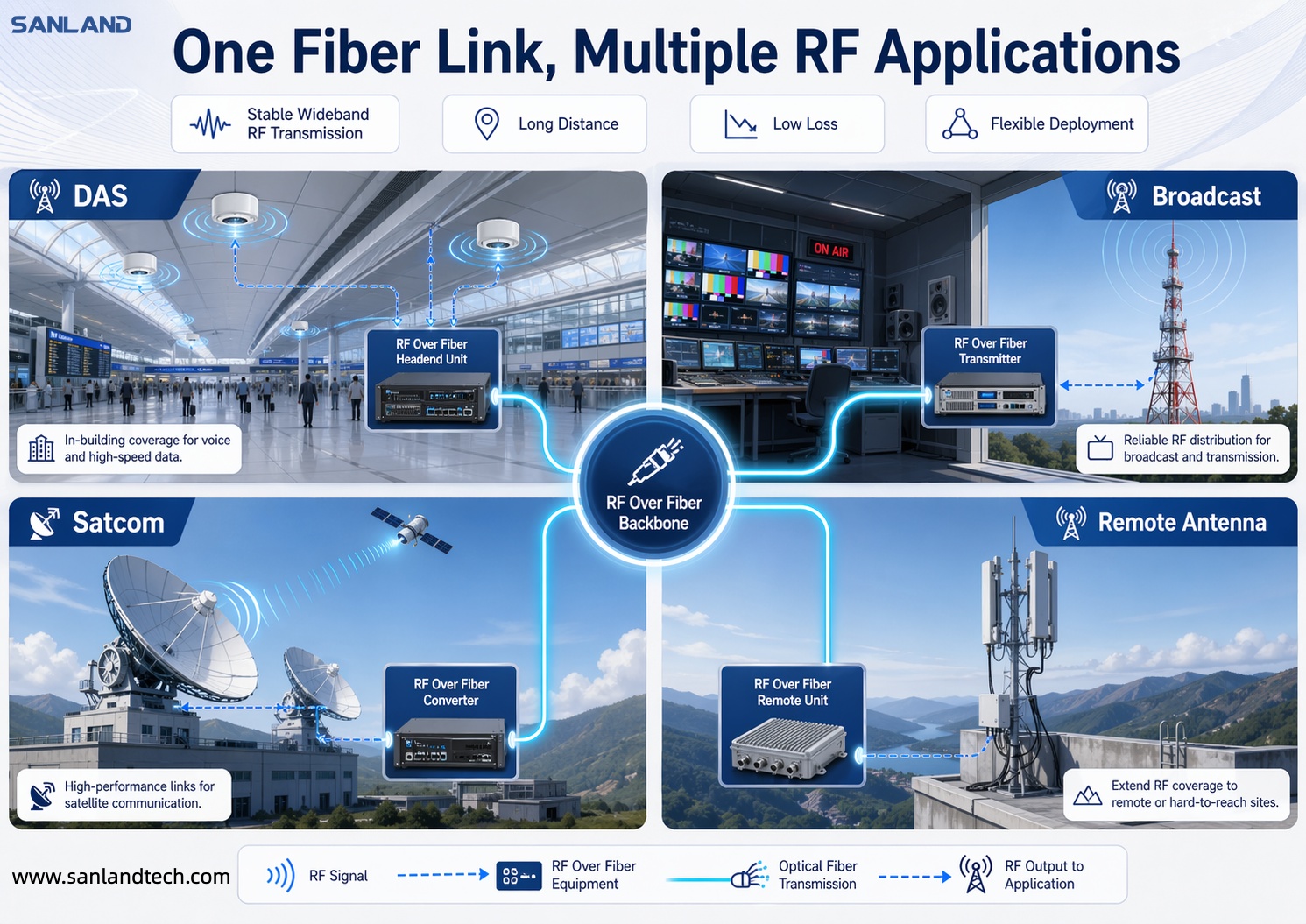
As RF systems become more distributed, transporting signals over long distances without degrading performance has become a major engineering challenge. In many deployments, traditional coaxial cable introduces too much attenuation, adds bulk, and limits installation flexibility. This is why RF over Fiber (RFoF) is increasingly used in applications such as DAS, broadcast, satcom, and remote antenna systems.
By converting RF signals into optical signals for transmission over fiber and then converting them back to RF at the far end, RF over Fiber provides a practical way to carry wideband signals over long distances with lower loss and greater immunity to electromagnetic interference. For applications that require stable RF transport, this makes fiber-based links an attractive alternative to long coax runs.
Why RF over Fiber Matters in Modern RF Networks
In modern communication and signal distribution systems, engineers often need to move RF signals between central equipment rooms and remote endpoints. The farther the distance, the more difficult it becomes to maintain signal quality using copper-based transmission alone. This is especially true in wideband applications where higher frequencies increase cable loss and make link performance harder to control.
RF over Fiber helps solve these problems by combining the bandwidth and low-loss characteristics of optical fiber with the signal handling requirements of RF systems. It is particularly useful in environments where long-distance transport, stable performance, compact installation, and flexible architecture are all important.
For many projects, the key advantages of RF over Fiber include:
- lower transmission loss over long distances
- immunity to EMI
- reduced cabling weight and installation complexity
- support for distributed or remote antenna locations
- stable transport of wideband RF signals
These benefits explain why RFoF is now widely considered in RF distribution networks across multiple industries.
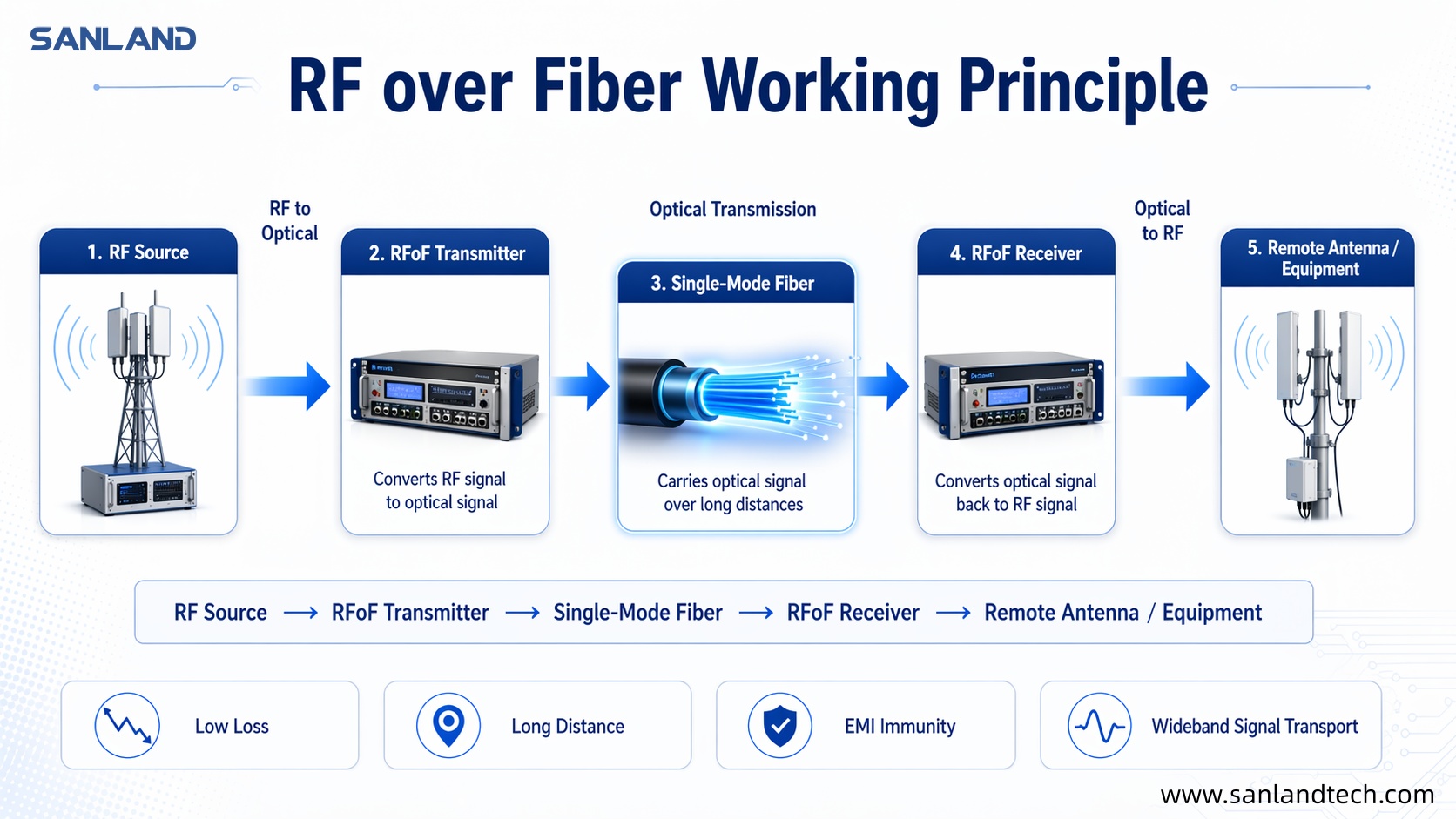
RF over Fiber in DAS
Distributed Antenna Systems are designed to improve wireless coverage in places such as airports, stadiums, office buildings, tunnels, campuses, and other large or complex environments. In these systems, RF signals often need to be transported from a central headend to multiple remote antenna units located far away from the equipment room.
Using coaxial cable over these distances can result in significant signal loss, especially across a wide frequency range. RF over Fiber offers a more efficient way to extend these RF links while preserving signal integrity. Because fiber allows long-distance transmission with lower loss, it helps DAS integrators build systems that are easier to scale and better suited for modern wireless coverage requirements.
This is particularly valuable in DAS projects that need to support multiple signal types, broad frequency coverage, and reliable performance across distributed infrastructure.
RF over Fiber in Broadcast Systems
Broadcast systems rely on consistent signal transport between studios, control rooms, transmission points, towers, and remote equipment locations. In these environments, maintaining RF signal quality is critical, especially when link distances increase or when traditional cabling becomes difficult to manage.
RF over Fiber is well suited for broadcast applications because it enables wideband RF transport over long distances while reducing the limitations associated with heavy coaxial infrastructure. It also supports cleaner system layouts and can help engineers avoid many of the practical challenges involved in long copper runs.
For broadcast and digital TV repeater systems, RFoF can provide a more stable and flexible transmission path, especially when equipment must be separated across facilities or outdoor infrastructure.
RF over Fiber in Satcom and Satellite Ground Stations
Satellite communication systems often require antennas to be positioned far from indoor equipment due to physical, environmental, or operational constraints. In these cases, transporting RF signals over conventional cable can negatively affect performance and complicate deployment.
RF over Fiber offers satcom integrators a practical alternative by enabling long-distance RF transport with better control over loss and signal stability. This is important in applications where link quality, linearity, and dynamic range have a direct impact on overall system performance.
For satellite ground stations and other satcom projects, RFoF can simplify system architecture while helping maintain the signal quality needed for demanding RF links. In many cases, it also provides greater flexibility in antenna placement and site design.
RF over Fiber in Remote Antenna Applications
Remote antenna deployments are one of the most common and practical use cases for RF over Fiber. When antennas must be installed on rooftops, towers, separated buildings, or other distant points, carrying RF over fiber becomes a highly effective way to bridge the distance between the antenna site and the main equipment location.
Compared with long coax runs, fiber-based RF transport can make installation easier, reduce signal degradation over distance, and support more compact remote system layouts. This is especially useful in communication systems where antenna location is driven by coverage, noise reduction, or physical installation constraints.
Remote antenna systems in wireless networks, broadcast infrastructure, satcom, and specialized sensing applications can all benefit from this approach.
Choosing the Right RF over Fiber Solution
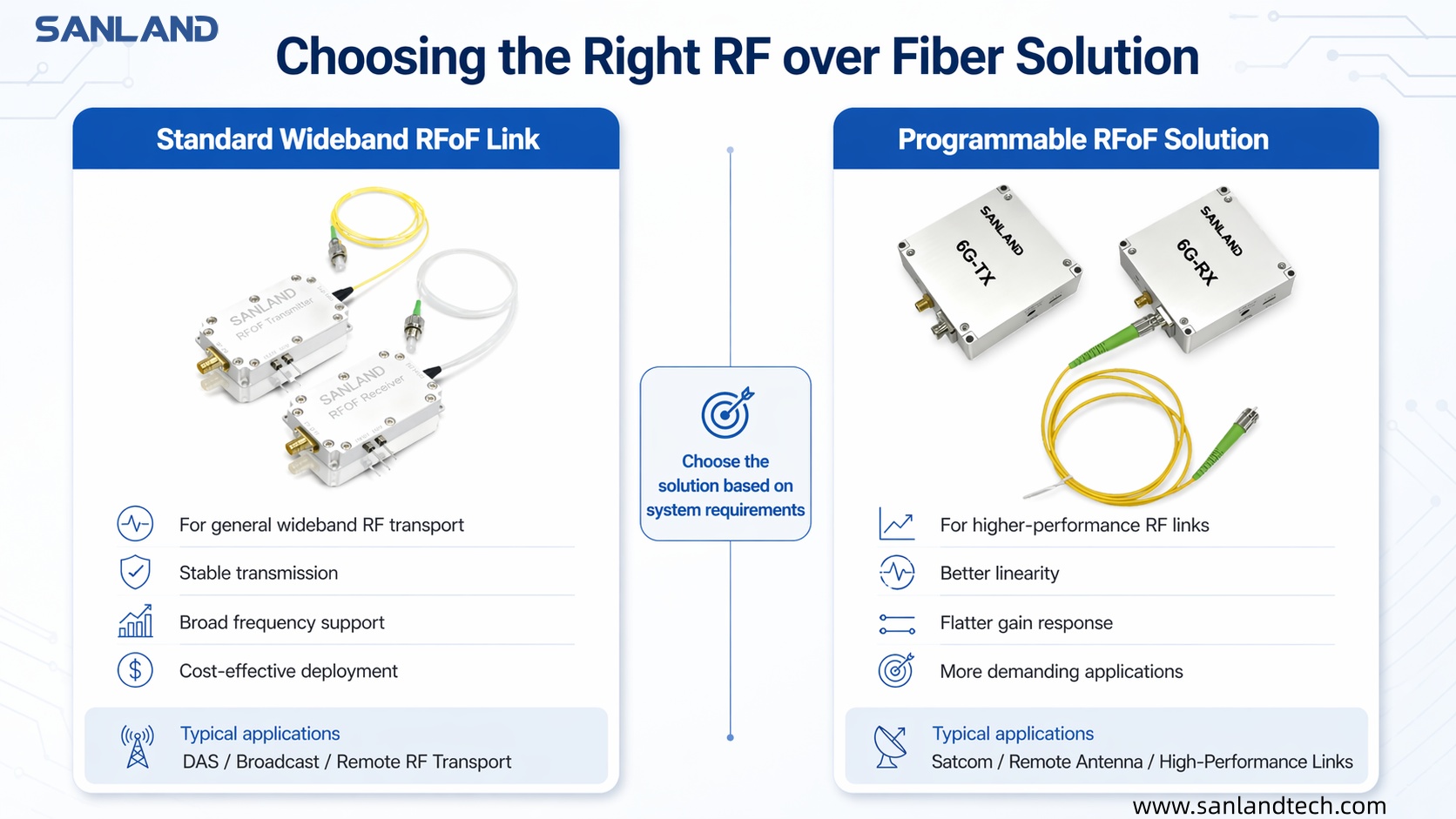
Not all RF over Fiber links are designed for exactly the same requirements. In practice, the right solution depends on the frequency range, link distance, system architecture, and performance expectations of the application.
For general wideband RF transport, a standard RF over Fiber link can be a strong choice when the goal is stable transmission, broad frequency support, and cost-effective deployment. This type of solution is often suitable for DAS, broadcast distribution, remote RF transport, and other wideband communication systems.
For more demanding environments, a programmable RF over Fiber solution may be a better fit. This is particularly true in applications where improved linearity, flatter gain response, and tighter RF performance control are important. In systems such as satcom, remote antennas, and higher-performance broadcast links, these characteristics can make a meaningful difference in overall link quality.
In other words, the selection often comes down to whether the project primarily needs reliable wideband RF transport or a more performance-focused solution with enhanced RF characteristics.
Final Thoughts
As RF networks continue to expand in scale and complexity, signal transport is becoming just as important as signal generation and reception. Engineers working in DAS, broadcast, satcom, and remote antenna applications need transmission methods that can support longer distances, wider bandwidths, and more flexible deployments without introducing unnecessary loss or complexity.
RF over Fiber addresses these needs by combining optical fiber’s transmission advantages with the practical requirements of RF systems. For projects that require stable wideband RF transport, it offers a proven and scalable path forward.
Whether the goal is broad RF distribution or higher-performance signal transport, RF over Fiber remains an increasingly valuable solution for modern RF infrastructure.