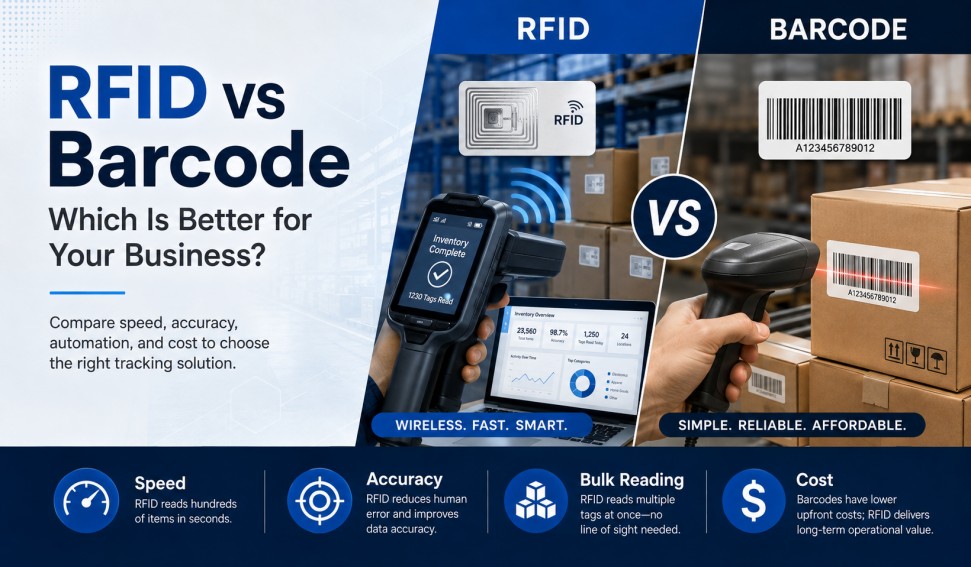
RFID vs barcode is not a contest with one universal winner. Both technologies identify physical items, and many successful operations use them together. The correct choice depends on the workflow, item value, volume, environment, automation requirement, infrastructure, and acceptable cost.
Barcodes are simple, visible, economical, and globally established. RFID can identify items without optical line of sight, support rapid multi-item reads, and automate movements at fixed locations. Those strengths make RFID valuable for inventory, logistics, manufacturing, and asset tracking, but they do not make barcodes obsolete.
This guide compares RFID and barcode systems so businesses can decide when to keep barcodes, when to add RFID, and when a hybrid approach provides the best result.
The Core Difference Between RFID and Barcode
A barcode stores data in a printed optical symbol. A laser or image-based scanner must see the symbol and decode it.
An RFID tag stores data electronically on a chip connected to an antenna. A compatible reader communicates with the tag through radio waves.
That difference changes the workflow:
-
Barcode scanning usually requires the operator to find, orient, and scan each symbol.
-
RFID can identify tagged items without optical line of sight and may read multiple tags within a designed RF zone.
RFID vs Barcode Comparison Table
| Factor | Barcode | RFID |
| Communication | Optical | Radio frequency |
| Line of sight | Required | Optical line of sight not required |
| Items per read action | Usually one symbol at a time | Multiple tags may be identified in one zone |
| Read distance | Close, scanner dependent | From close tap to several meters, depending on system |
| Data carrier cost | Very low | Higher than printed barcode |
| Infrastructure cost | Generally lower | Generally higher |
| Visibility to users | Human-visible symbol and text | Chip data is not visible without a reader |
| Writable data | Printed symbol cannot be electronically rewritten | Some tag memory can be rewritten or locked |
| Automation potential | Good with fixed imaging and conveyors | Strong for portals, shelves, cabinets, and bulk reads |
| Material sensitivity | Print quality, dirt, damage, lighting | RF effects from metal, liquids, orientation, interference |
| Smartphone interaction | QR codes and some 2D codes | NFC tags; UHF usually needs a dedicated reader |
| Best fit | Low-cost identification and direct scanning | High-volume identification, automation, and visibility |
Advantages of Barcode Systems
Low Data-Carrier Cost
A barcode can be printed directly on packaging or a standard label. This makes it practical for inexpensive products and large global supply chains.
Simple Deployment
Barcode scanners, printers, software, and standards are mature and widely available. Employees are familiar with the scan-and-confirm workflow.
Visible Information
A barcode label can include human-readable numbers, descriptions, dates, and instructions. Even when the symbol cannot be scanned, a person may still read the printed information.
Controlled Intentional Scanning
Because the scanner must see the code, a barcode process can clearly indicate which item the operator intended to scan.
Strong Point-of-Sale Ecosystem
EAN/UPC and other GS1 barcodes are deeply established in retail and distribution. Emerging 2D barcode programs add more product data and web connectivity without eliminating existing barcode infrastructure.
Limitations of Barcode Systems
Line of Sight
The scanner must see the symbol. Labels may need to be turned, unpacked, or located before scanning.
One-at-a-Time Workflow
Most barcode processes require individual scans. This can become labor-intensive when counting thousands of items.
Print Damage and Contamination
Scratches, folds, poor contrast, dirt, condensation, and missing labels can prevent reliable scanning.
Limited Automatic Movement Capture
Fixed barcode imaging can automate some conveyor workflows, but product orientation and label visibility must be controlled.
Advantages of RFID Systems
No Optical Line of Sight
RFID does not require a camera or laser to see the tag. Tags can sometimes be read through non-metallic packaging, although materials and shielding still affect RF communication.
Multi-Item Identification
A properly designed UHF RFID system can identify many tagged items in a read zone, accelerating stock counts and shipment verification.
Automatic Read Points
Fixed readers can record items moving through doors, conveyors, tunnels, cabinets, or production stations without a manual scan for every item.
Unique Item-Level Identification
RFID can assign a unique electronic identifier to each item rather than identifying only the product type. This supports serial-level inventory, traceability, returns, authentication, and lifecycle records.
Writable or Controllable Memory
Some RFID tags support writable memory, lock states, passwords, or security features. Capability depends on the chip and application design.
Durable Tag Options
Hard tags, ceramic tags, PCB tags, laundry tags, and encapsulated industrial tags can survive environments where a printed barcode label would fail.
Limitations of RFID Systems
Higher Cost
RFID tags cost more than printed barcodes, and the system may require readers, antennas, middleware, integration, testing, and maintenance.
RF Engineering
Metal, liquids, tag orientation, reflections, nearby inventory, and reader settings can affect performance. Site testing is essential.
Unintended Reads
A reader may detect tags outside the intended process zone unless the hardware, shielding, power, sensors, and software rules are carefully designed.
Less Human-Readable by Default
The electronic identifier is invisible. Many RFID labels therefore include a printed barcode, serial number, and text as a visual backup.
Integration Requirements
RFID can generate many repeated reads. Middleware must turn them into meaningful events and connect them with existing systems.
When Barcode Is the Better Choice
Barcode is often the best option when:
-
Data-carrier cost must be extremely low
-
Items are scanned individually at a controlled point
-
Optical access to the label is easy
-
The current process already performs well
-
Human-readable information is important
-
A globally established retail barcode is required
-
The item does not justify RFID infrastructure
-
The operation has low volume and limited automation needs
A simple technology that solves the problem reliably should not be replaced merely because a more advanced option exists. Humanity has already invented enough expensive ways to solve problems that were not actually problems.
When RFID Is the Better Choice
RFID is often more valuable when:
-
Inventory counts are frequent and labor-intensive
-
Many items must be identified quickly
-
Line-of-sight scanning creates delays
-
Item-level visibility is required
-
Movements must be captured automatically
-
Assets are repeatedly audited or searched
-
Products move through warehouses, factories, laundries, or stores
-
Durable embedded identification is needed
-
Returns, authenticity, maintenance, or lifecycle tracking matter
The strongest RFID business cases usually come from workflow improvement, not from replacing a barcode symbol with a radio tag while leaving every process unchanged.
Why Many Businesses Use RFID and Barcode Together
RFID and barcode are complementary.
A common smart label includes:
-
A UHF RFID inlay for fast inventory
-
A printed GS1 barcode for established scanning systems
-
A serial number for human reference
-
A QR code or 2D barcode for digital information
This hybrid design provides redundancy and supports different partners across the supply chain.
Examples include:
Retail Apparel
RFID supports store inventory and replenishment, while the printed barcode supports point-of-sale and partners without RFID readers.
Warehouse Operations
RFID portals verify tagged cartons automatically, while barcodes handle exceptions, untagged items, and carrier documentation.
Healthcare
A barcode may remain the primary regulated identifier, while RFID supports asset location, cabinet management, or internal workflow visibility.
Manufacturing
RFID identifies carriers, tools, or work-in-process automatically, while barcodes support manual confirmation and printed documentation.
How to Compare RFID and Barcode ROI
Do not compare only the cost of one barcode label with one RFID tag. Compare the full process.
Current Process Costs
-
Labor used for scanning and counting
-
Time spent locating items
-
Inventory discrepancies
-
Shipping and picking errors
-
Production delays
-
Lost assets and tools
-
Stockouts and overstock
-
Rework and exception handling
RFID Project Costs
-
RFID tags or labels
-
Readers and antennas
-
Installation and network infrastructure
-
Software and integration
-
Testing and pilot work
-
Training and process redesign
-
Maintenance and support
Benefits to Measure
-
Time saved per count or transaction
-
Increased inventory frequency
-
Reduced search time
-
Fewer errors
-
Improved stock availability
-
Better asset utilization
-
Faster receiving and shipping
-
Improved traceability
-
Reduced loss
A pilot should establish measurable baseline and post-implementation results.
A Practical Decision Framework
-
Map the current workflow.
-
Identify the specific bottleneck.
-
Measure volume, labor, error rate, and process time.
-
Decide whether one-at-a-time scanning is acceptable.
-
Evaluate item materials and tag placement.
-
Estimate hardware and integration requirements.
-
Test barcode, RFID, or hybrid alternatives.
-
Calculate total cost and operational benefit.
-
Run a pilot with success criteria.
-
Scale only after repeatable results are confirmed.
Frequently Asked Questions
Will RFID replace barcodes?
Not completely. Barcodes remain economical, visible, and widely accepted. RFID is added where automatic, non-line-of-sight, or multi-item identification creates enough operational value. Many products carry both.
Is RFID more accurate than barcode?
Either technology can be accurate when correctly implemented. RFID can reduce missed manual scans and speed inventory, but poorly designed read zones may create missed or stray reads. Accuracy depends on the complete process.
Is RFID always faster?
RFID is often faster for bulk inventory and automatic movement capture. For one controlled item at a checkout or workstation, barcode scanning may be equally practical.
Can RFID work if the barcode is damaged?
Yes, if the RFID inlay and antenna remain functional. Conversely, the printed barcode may still work if the RFID component is damaged. This is one reason hybrid labels are useful.
Which technology costs less?
The barcode data carrier usually costs less. RFID may lower total operating cost when it reduces labor, errors, losses, or delays enough to justify the infrastructure.
Conclusion
RFID vs barcode is a workflow decision. Barcode remains an excellent choice for low-cost, visible, one-at-a-time identification. RFID is stronger when businesses need rapid inventory, automatic reads, serial-level visibility, durable tags, or reduced dependence on manual scanning.
In many operations, the best architecture uses both: RFID for automation and visibility, barcode for compatibility and visual backup.
Evaluating RFID for an existing barcode process? GSRFID can help test item materials, tag formats, read zones, readers, printing, encoding, and hybrid label designs before a broader deployment.